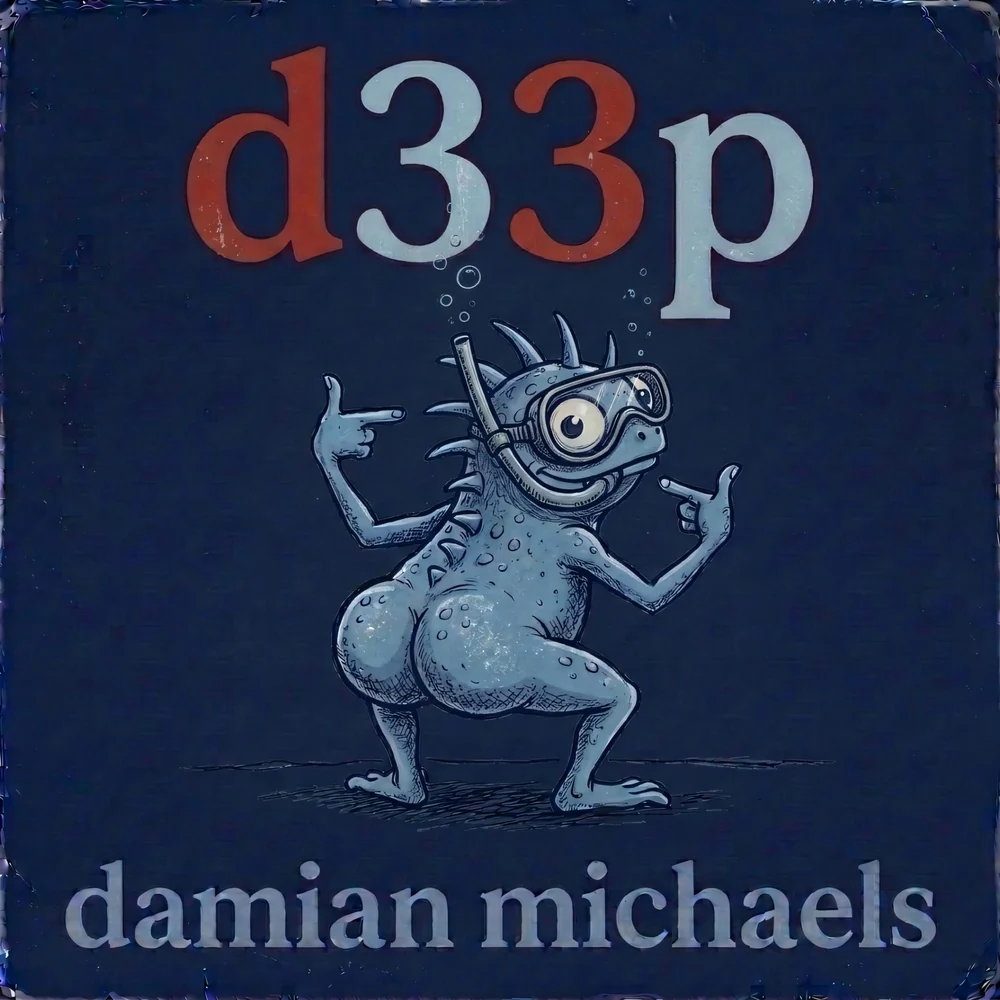
the beautiful version.
“d33p” is the quieter half of a memory that refuses to stay quiet.
Built around a soft, almost devotional chorus, the song returns again and again to the same uncomplicated loss while its verses construct an increasingly elaborate, sexual and often grotesque religion around it. Angels, communion, rapture, saints and sacramental imagery become instruments of longing, recruited to make one person's absence feel large enough to survive.
At its centre is a deceptively simple confession: “You were mine for a second.” Everything surrounding that admission seems designed to avoid its smallness. The language grows grander, the imagery more excessive, and ordinary intimacy is transformed into something approaching religious ceremony. Yet the chorus remains almost embarrassingly direct. For all the mythology the narrator creates, he cannot change the fact that someone was there, and then they weren't.
Sex and devotion become intertwined forms of unsuccessful grief management. Physical encounters offer the possibility of distraction, replacement or temporary communion, but none can restore what has disappeared. The narrator increasingly casts himself as the religious figure, the object of worship or the person administering the sacrament. There is a suggestion of control in this transformation: if he can make himself divine, perhaps he can reclaim some authority over a story in which he was otherwise powerless. The attempt does not appear to be working.
Much of the song's tension comes from the contrast between its musical tenderness and the increasingly obscene imagery of its verses. The warmth is deliberate. Memory does not necessarily preserve events according to their emotional consequences, and something painful can return sounding beautiful, comforting or even desirable. The music seems to protect the version of the memory that still feels good, while the lyrics gradually reveal what that version cannot contain.
The ocean functions as both an emotional landscape and a measure of absence. Its depth suggests something immense and difficult to understand, while the recurring ocean gap becomes a space that no amount of beauty, intimacy or spiritual devotion can fill. Even the angels are inadequate. The problem is not a lack of people willing to occupy the space, but the impossibility of turning someone new into someone who has already gone.
The song's humour and blasphemy complicate its grief rather than diminish it. Its exaggerated sexuality, corrupted holiness and occasional absurdity make the narrator's desperation easier to approach without making it any less sincere. What initially sounds like irreverence gradually reveals itself as another way of pleading for something that cannot be returned.
“d33p” is ultimately less concerned with whether a relationship was significant enough to justify such extravagant mourning than with the strange, disproportionate ways people experience loss. Something that lasted only a moment can become the centre of an entire private mythology.
Its companion, “d33p again” ↗, returns to that same absence after time and repetition have begun to change the story. Where “d33p” still seems capable of preserving the beautiful version, the later song begins to question what the narrator has been preserving, and why he cannot seem to stop.
why do the verses sound so sexual when the chorus is so sad?
“Because sex is doing a lot of unsuccessful grief management in this song. The verses keep getting bigger, dirtier and more religious while the chorus keeps returning to one very boring fact: somebody was there, and then they weren't.”
why is “you were mine for a second” so much simpler than everything around it?
“Because I think that's the sentence all the other language is trying not to say. You can build an entire cathedral around a loss and still end up standing in the middle of it saying, ‘I had you for a second.’”